.png?width=250&height=34&name=BS-logo-pb%20(1).png)
Why this matters
- Faster checkout
- Reduce manual payments
- Improve cash flow
🗒️ Note: This is a paid feature — contact your Brandscope Account Manager to enable it
📝 Note: The Stripe user interface has been slightly updated since the making of this video. There will be a difference from 1:09 min of the video (step 5.) below. We recommend you follow steps 5 through 7 as written below.
Step 1: Connect Stripe to Brandscope
- Contact your Brandscope Account Manager if you'd like to set up Stripe payments on your account.
- Go to Profiles → Company Profile → Payments tab
- Click Connect to Stripe
- You will be redirected to Stripe
Then:
- Log in with an existing Stripe account
OR - Create a new Stripe account using your email
Once complete, you’ll be redirected back to Brandscope
Step 2: Set Up Tax Rates in Stripe
- Log into Stripe
- Naivgate on Stripe Interface and go to More → Product Catalog → Tax Rates
- Click + New
Enter:
- Type
- Region
- Rate
- Select Exclusive (for B2B)
- Add description
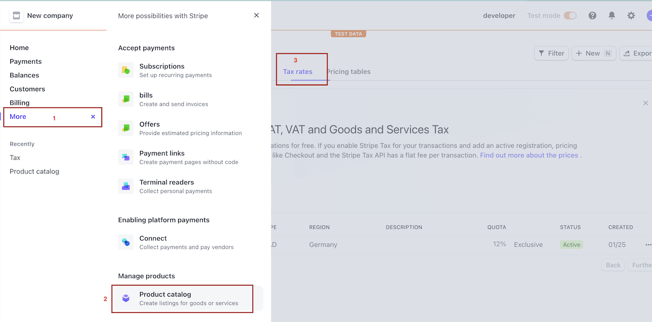

Your tax rate has been created. You can add additional tax rates, if needed.
Step 3: Enable Payments in Brandscope
- Contact your Brandscope Account Manager to enable settings then go to Setup → Brands
- Select your brand
- Scroll down
Enable:
- Enable Payments
- Accept Stripe Payments

Step 4: Configure Payment Settings
- Set a “Pay Now” percentage (optional)
- Choose QuickFill payment option:
- Submit only
- Pay now only
- Both
Click Save
Warning: This can also be overwritten on the brand settings tab: Setup > Account & Shipping Codes > Brand/Retailer Settings > Scroll right > Discount % page > Double click into field > update number > enter)
Step 5: Configure Retailer Payment Settings
- Go to Setup → Brand/Retailer Settings → Retailer Payment Settings
- Scroll to Tax Country
- Enter:
- Country
- Tax type (e.g. GST, VAT)
You can control whether retailers are required to pay at checkout:
- Enforce Payment (Indent) → True / False
- Enforce Payment (In-Season / QuickFill) → True / False
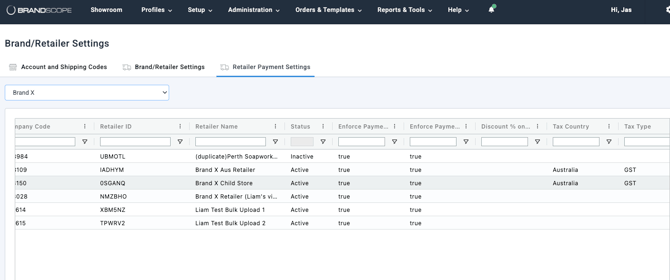
💡 Tip: If you need to update payment settings for multiple retailers. Complete the Retailer Payment Settings bulk file and send it to your Brandscope Account Manager
Step 6: Set Up Postage (Freight Costs)
- Go to Setup → Pricing → Postage Schemes
- Click + Add New
- Enter:
- Name
- Description
- Activate toggle
- Click Save
Step 7: Add Postage Rules
- Select your scheme
- Click + Add New Postage Rule
- Enter:
- Currency
- Rule type
- Minimum / Maximum
- Amount
- Save

 In the above example, a $30 charge will be applied to any order under $500.
Step 8: Assign to Retailers
- Go to Assign tab
- Select:
- Brand
- Postage scheme
- Retailers
- Click Assign
Step 9: Enable Payments on Releases
- Go to Setup → Releases
- Select release → click Edit
- Scroll to Payment Settings
- Choose:
- Submit only
- Pay now only
- Both
- Click Save

BECS Transaction Limits (Australia)
For the “BECS Direct Debit in Australia” payment option there’s a default limit of $1,500 AUD per transaction and $4,500 AUD per week (read the official Stripe documentation here).
The reason for these default limits is that the BECS transaction method is a high trust method that doesn’t have many fraud controls.
💡 Tip: If the default limit is not enough for your business, we advise you to get in touch with the stripe support team early in the onboarding process to get this limit increased.
Troubleshooting
- Payments not showing? → Confirm “Enable Payments” is turned on
- Tax not applying? → Check Stripe tax setup + Brandscope tax country
- Retailers can’t pay? → Check release payment settings
🔗 Related Articles